
Legally Blonde, Unapologetically Driven
Law clerk Virág Ahiakpor is rewriting the rules of professional ambition—one runway show at a time.
By Ava Reid for Sublime Avenue Magazine. Photography: Duy Ho, Natalia Polros
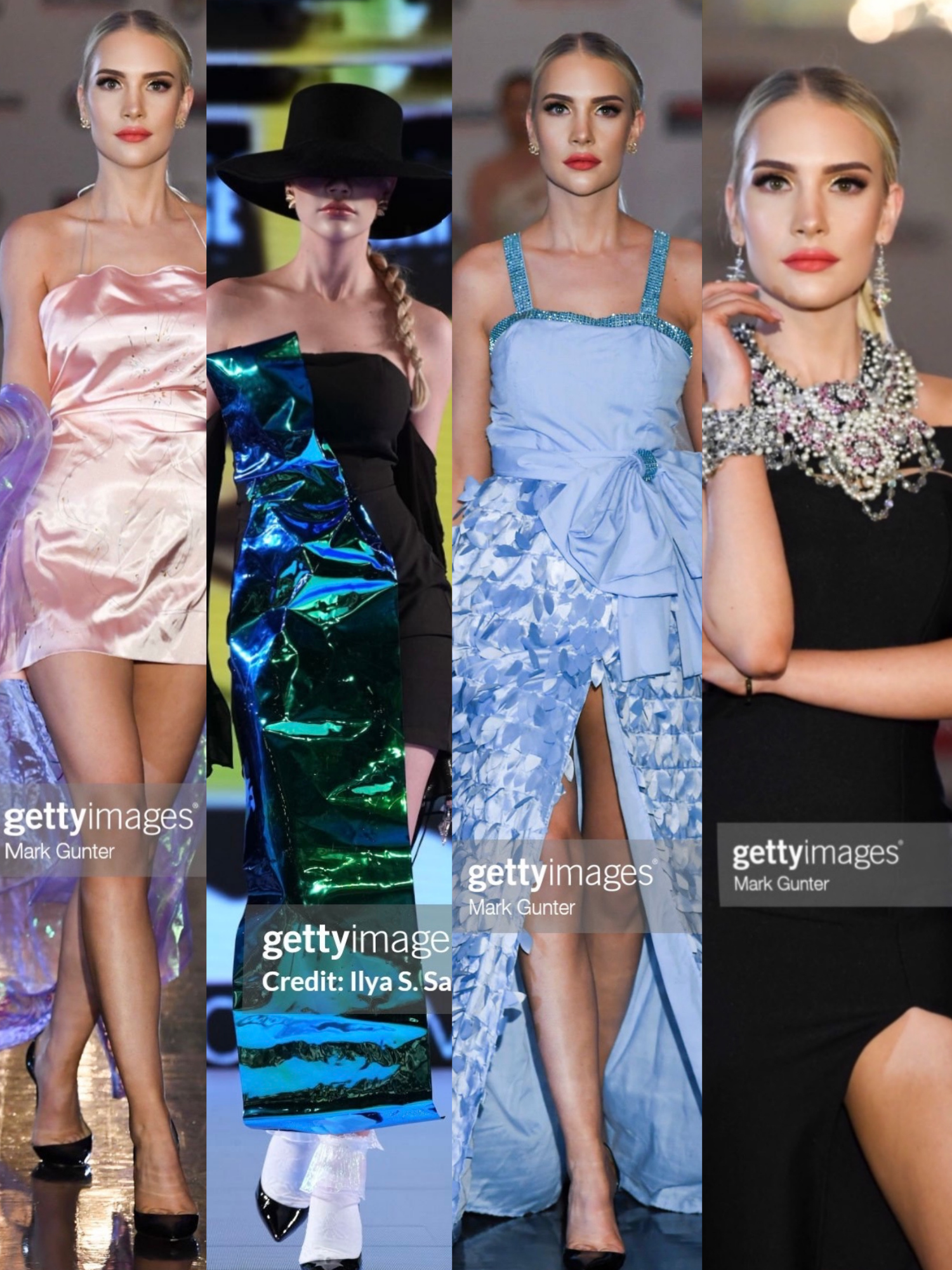
On a Friday afternoon last fall, while her Harvard-educated bosses were buried in briefs at their Manhattan law firm, Virág Ahiakpor slipped away to New York Fashion Week. The 5'9" Hungarian transplant spent the day backstage with models who complained about the marathon schedule—morning to night, hair and makeup, the endless waiting. Ahiakpor, however, felt like she was on vacation.
This is the paradox of Virág Ahiakpor: For her, Fashion Week is the break from real work.
"Comparing it to my current job, it felt amazing," she recalls with the pragmatic charm of someone who once worked 8 a.m. to midnight. "Being with my girlfriends, it's like a girly day. I seriously had a great time."

At an age when most young professionals are still finding their footing, the twenty-something Ahiakpor is living what appears to be two completely separate lives. By day, she's a law clerk at a conservative all-male Manhattan firm, building the foundation for her dream of one day running her own corporate law practice. By weekend, she's signed with a New York modeling agency, walking runways and doing shoots when her 9-to-5 (or more accurately, 8-to-midnight) allows.
Her Instagram suggests glamour. Her reality suggests something more complicated: relentless ambition wrapped in Elsa Hosk's aesthetic.

The Bossy Girl from Budapest
The origin story begins, as so many Eastern European professional tales do, with parental expectations. "There's kind of a meme in Eastern Europe that your parents are proud of you if you're either a lawyer or a doctor," Ahiakpor explains. Though her parents never pushed her toward either field, the cultural script was clear.
She initially aimed for veterinary medicine—ironically, the most competitive field in Hungary, with only one veterinary university in the entire country. But blood proved to be a dealbreaker. Law school it would be, fortified by her biology-focused high school's Latin curriculum. (Continental law, practiced throughout Europe except in the UK and Ireland, has its roots in ancient Roman legal codes—those Latin classes would prove unexpectedly useful.)

But there were other influences too. At nine, she was reading Agatha Christie. At ten, she was begging her parents to let her stay up late to watch CSI. "I was very bossy as a child," she admits. "I always had a script in my mind for how things were supposed to go, and I was upset if it didn't happen."
I was measuring how many stamps I did a day. I did 200 one day, and the next day I wanted to do 300. Always more.

Legally Blonde, Actually
Elle Woods would be proud. Like Reese Witherspoon's pink-clad Harvard Law student, Ahiakpor saw no contradiction between beauty and brains. "I also saw the movie Legally Blonde," she says, "and it was very impressive to me—to be pretty and smart."
Modeling agencies started approaching her at 14. By 15, with her parents' blessing (and supervision—her uncle accompanied her to the first casting), she signed with an agency in Budapest. It seemed practical: why pay for ballet or ice skating lessons when someone would pay her to be on camera?
But law remained the real passion. During high school, faced with eight classes a day that ran from 7 a.m. to 4 p.m., she made strategic choices. Art class? Music? "I knew I had nothing to do with that," she says. "So when it was like the eighth class of the day, I was skipping those classes and I went to castings."
The teachers, she suspects, understood. Or at least didn't report her.
The Atlantic Divide
Moving to America with a European law degree is, as Ahiakpor discovered, an exercise in starting over. Continental law and common law are fundamentally different systems. She attempted the California bar exam one of the few states that allows foreign law graduates to sit for the bar—but found herself consistently thrown. "Even when I felt like, okay, I got this question, I remember this topic, it was thecomplete opposite."
Friends in Big Law were blunt: if she wanted a real career, she'd need to return to law school for a J.D. The shortcut—an LLM degree—wouldn't cut it for serious advancement.
So she's building from the ground up, working as a law clerk while planning her next academic move. But here's where the story deviates from the typical struggling-immigrant narrative: "I basically sat in a fancy office as my first job in the U.S.," she notes, almost sheepishly aware of her luck. She'd heard horror stories from other Hungarian lawyers who had to take additional jobs just to afford parking at the firms where they interned.

The Mathematics Ambition
Ahiakpor's current life is a study in time management and trade-offs. She's signed with a respected New York agency (she declines to name it), but they want full-time models—people available for weekday shoots and last-minute bookings. She's strictly a weekend model, which means watching amazing opportunities pass by.
"My lawyer friends understand it," she says of her work-obsessed schedule, "but my non-lawyer friends—I feel like I annoy them sometimes because I work so much."
And yet: "Sometimes I can just let people take care of me, take care of my makeup and my hair," she says of modeling. "It feels like a spa."

Sometimes I can just let people take care of me, take care of my makeup and my hair. It feels like a spa.
The Hungarian in New York
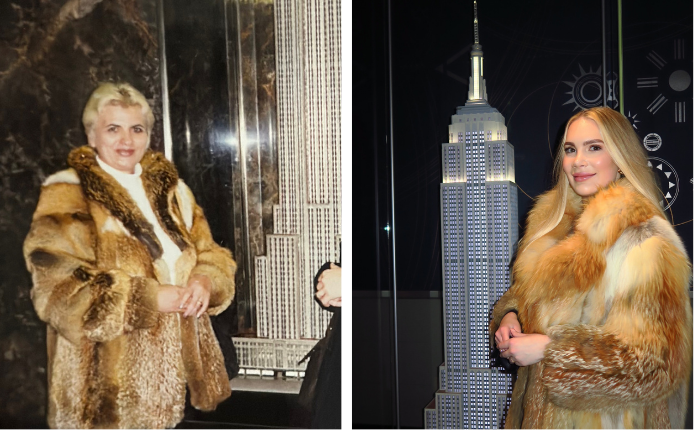
There's a certain irony to Ahiakpor's journey. She moved to America—specifically to New York, the city her grandmother visited in the '90s and made seem impossibly glamorous—to pursue bigger dreams than Hungary could contain. But she's discovered that being Hungarian in America means carrying certain cultural traits that don't always translate.

Hungarians, she's learned, are not known for their warmth toward strangers—even other Hungarians. She once encountered a Hungarian couple on a New York street and excitedly greeted them in her native language. The elderly woman's response? "Well, okay, fine. Have a good night."
"Since then, I don't even try to talk to someone," Ahiakpor laughs. A Ukrainian friend theorizes that Hungarians are closer to Russian reserve than Ukrainian openness, that speaking one's mother tongue creates a vulnerability that feels too intimate with strangers.

She celebrates Orthodox Christmas in January ("January is like a depressive month—it's much better to have Christmas then") and has found her people among Eastern Europeans in New York's vast diaspora. San Francisco, where she lived briefly, felt harder for making friends, perhaps because there were fewer people who understood this particular brand of post-Soviet pragmatism wrapped in high fashion.
What She Tells Her Eleven-Year-Old Self
Ask Ahiakpor what advice she'd give her younger, bossier self, and the answer is simple: "We did it. So she doesn't have to worry too much."
The dreams were big—move to America, practice law, walk runways, build something substantial. She was impatient then, worried about timing, about whether it would all happen. "But I really believed in them," she says. "I would have never given up."

This is the modern calculus of ambition: a woman who measures success not in traditional milestones but in office doors with her name on them, in fashion shows that feel like freedom, in the hard-won ability to pursue both the analytical and the aesthetic without apology.
The Price of Duality
There's a moment in the interview when Ahiakpor reveals something telling about her dual existence. Asked how people can reach her, the introvert in her emerges: "I might not be quick responding. It's a difficult question for an introvert—how can people find you? I don't want people to find me."
Here is the real Virág Ahiakpor, beyond the runway photos and the law firm gravitas: someone who has learned that you can be visible and private, ambitious and reserved, beautiful and serious. That you can skip art class for castings and still become the person who stays late reading case law. That moving 4,000 miles from home doesn't mean abandoning who you are—it means finding spaces where all your contradictions can coexist.

"It's a difficult question for an introvert—how can people find you? I don't want people to find me."
Her modeling agency wants more availability. The legal career demands more education. The balance is precarious, probably unsustainable long-term. But for now, she's doing what that bossy nine-year-old with the Barbie magazine and the big dreams always knew how to do: more than expected, better than required, on her own terms.
When asked about swapping closets with any celebrity, she chooses Elsa Hosk—the Victoria's Secret model who launched her own design line. It's a revealing choice: someone who used modeling as a platform, not an endpoint. Someone who built something that was hers.
That eleven-year-old in Budapest, counting stamps at her mother's law office and plotting her American dream? She's going to be just fine.
Virág Ahiakpor can occasionally be found on Instagram, when work permits. Her favorite book is "Atomic Habits." Her favorite Hungarian film is "Children of Glory," about Hungary during the USSR era. Her Disney princess alter ego is Anastasia—the lost royal who found her way home against impossible odds.